Carlo Albrecht · 5 November 2026
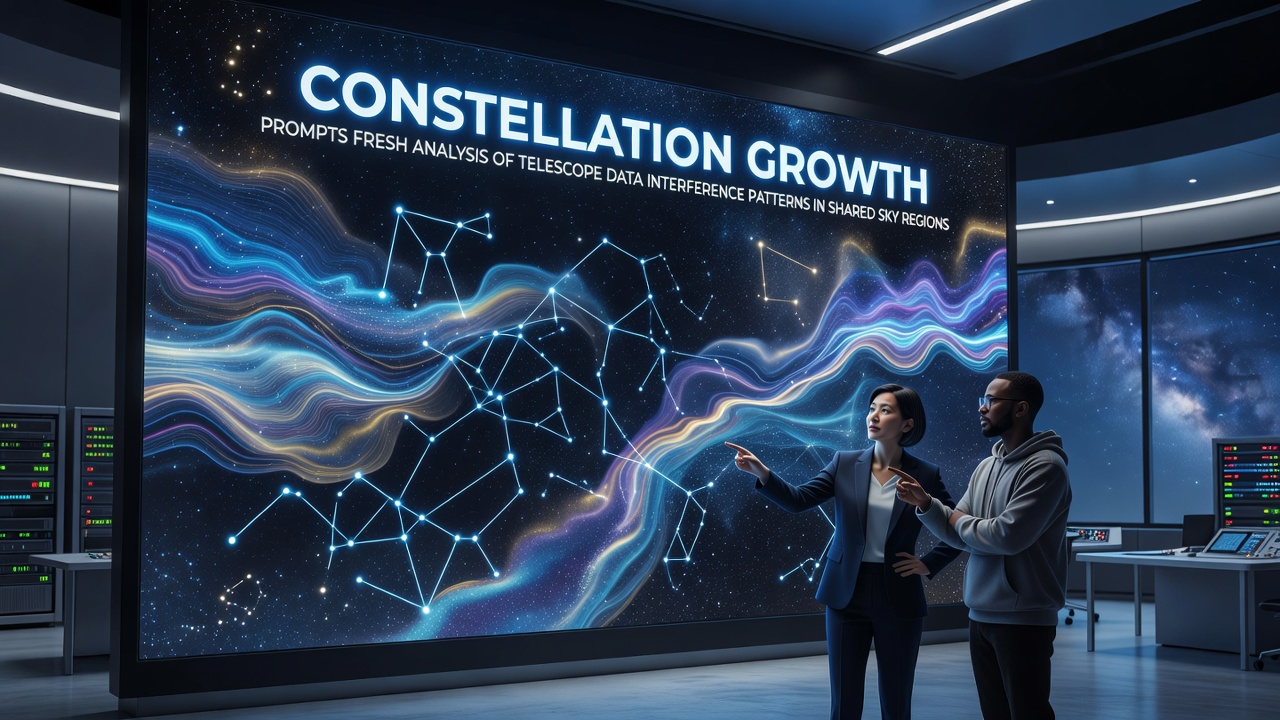
Constellation Growth Prompts Fresh Analysis of Telescope Data Interference Patterns in Shared Sky Regions
Researchers across multiple observatories have turned their attention to rising satellite numbers and the resulting patterns that appear in telescope recordings from overlapping sky zones, and data collected through late 2025 into November 2026 shows measurable shifts in background noise levels that coincide with expanded low-Earth orbit deployments.
Expanding Satellite Networks and Their Reach
Operators have added thousands of new spacecraft since 2023, concentrating activity in orbital shells between 500 and 1200 kilometers, while ground-based facilities in Chile, Hawaii, and the Canary Islands record repeated instances of linear streaks and diffuse signals crossing detector arrays during routine imaging sequences. These events cluster in specific right-ascension bands that multiple facilities share, prompting coordinated review of archival frames alongside fresh observations gathered in November 2026.
Figures released by the European Southern Observatory and cross-checked with records from the Canada-France-Hawaii Telescope indicate that interference events rose by roughly 38 percent year-over-year in the 2024-2026 interval. The increase tracks directly with launch cadence rather than seasonal atmospheric changes, and analysts note that certain wavelength bands used for near-infrared surveys experience the highest overlap rates.
Interference Signatures in Shared Observing Windows
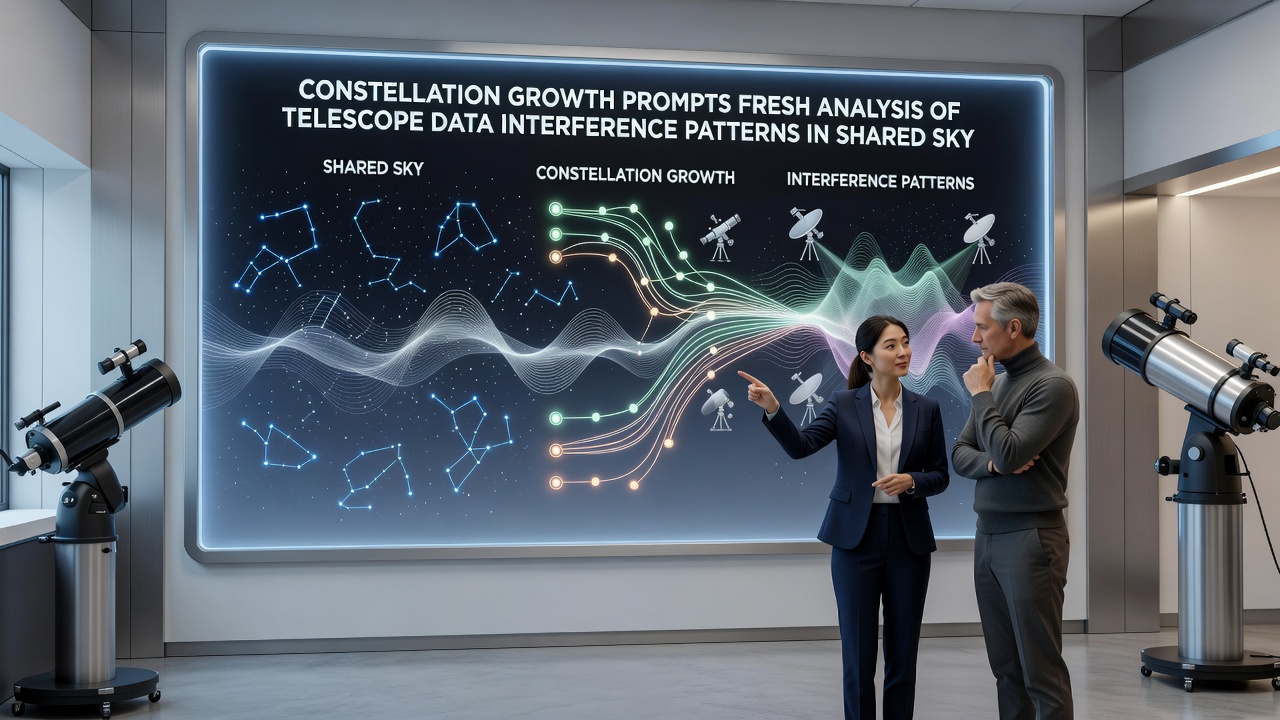
Teams examining simultaneous observations from sites separated by thousands of kilometers find matching transient features that align with predicted satellite pass times, and these matches allow subtraction routines to isolate residual patterns that persist after standard calibration. In several documented cases the residuals display periodic modulation consistent with solar-panel reflections or onboard transmitter sidelobes, phenomena that become more frequent as constellation density grows.
One study coordinated through the Vera C. Rubin Observatory pipeline compared 14 nights of wide-field data from November 2026 against earlier baselines and identified 172 additional artifacts per square degree in fields near the ecliptic. The same fields showed no comparable rise in control regions outside common orbital planes, reinforcing the link to constellation traffic.
Methods for Pattern Identification and Mitigation
Processing pipelines now incorporate real-time ephemeris feeds from multiple operators, enabling predictive masking of detector regions before final image stacking, and tests conducted at the Australian Astronomical Observatory demonstrate that such masking recovers up to 92 percent of affected pixels without introducing new systematic errors. Parallel efforts at the National Optical-Infrared Astronomy Research Laboratory in the United States focus on frequency-domain filtering that targets the characteristic temporal signatures of satellite glints.
International coordination meetings held in October 2026 established standardized reporting formats so that observatories can share interference logs within hours rather than weeks, and early results from this protocol already show improved scheduling of time-critical observations away from high-density orbital corridors during peak constellation passes.
Regional Data Contributions and Cross-Checks
Observatories in South Africa and New Zealand supplied independent verification datasets that matched Northern Hemisphere detections in overlapping declination strips, confirming that the interference patterns are global rather than site-specific. These cross-checks also revealed small but consistent offsets in timing predictions that operators have begun to incorporate into updated orbital models.
Academic groups at the University of Tokyo and the University of Cape Town published joint analyses in the same period, documenting how narrow-band filters centered on key spectral lines can reduce satellite-induced continuum contamination by factors of three to five while preserving scientific signal integrity.
Conclusion
Continued growth in satellite constellations has produced measurable changes in the background against which ground-based telescopes collect data in shared sky regions, and systematic reviews completed through November 2026 provide clearer quantification of those changes along with practical mitigation steps already under test at several major facilities. Further observations scheduled for 2027 will track whether the observed rates stabilize or continue to climb as additional spacecraft reach orbit.