
Carlo Albrecht · 24 September 2026
UN Debates Intensify Over Low Earth Orbit Traffic Rules While NORAD Data Shows Debris Growth Impacting AI Conjunction Forecasts
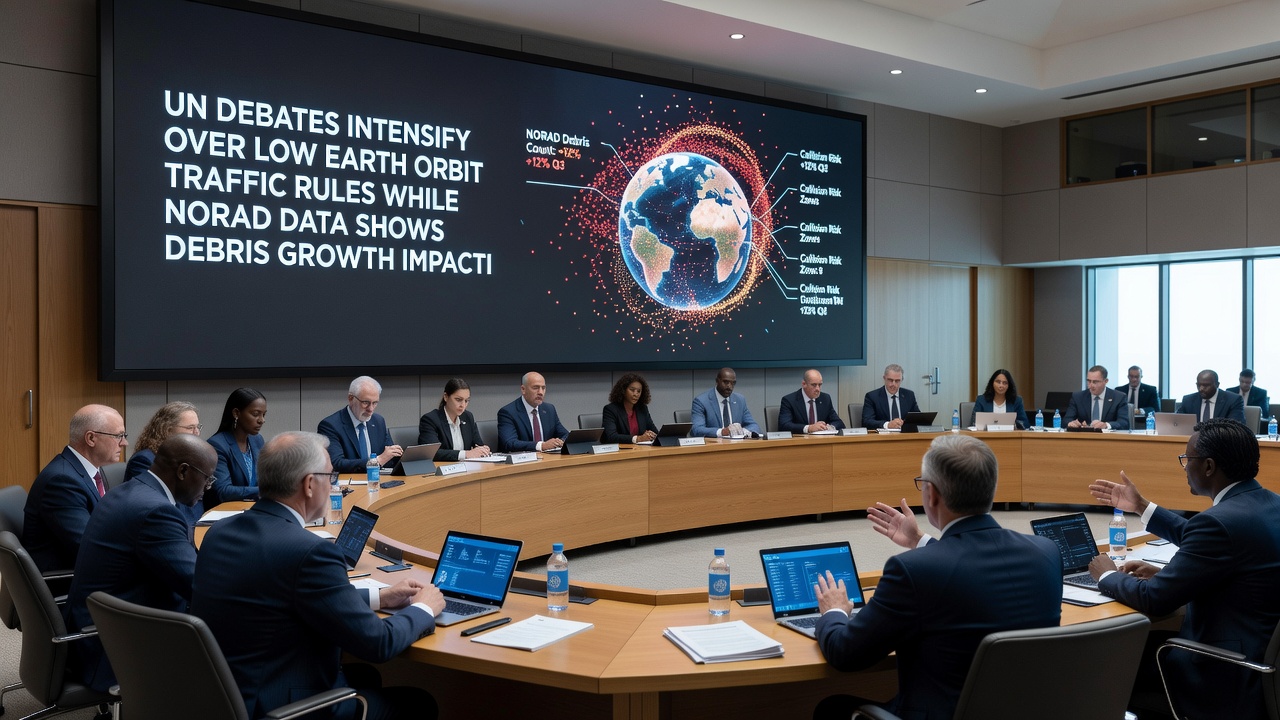
Delegates at the United Nations Committee on the Peaceful Uses of Outer Space have escalated discussions on standardized traffic rules for low Earth orbit since early 2025, with sessions in September 2026 scheduled to address binding coordination mechanisms that could reduce collision risks amid rising satellite deployments. Data compiled by the North American Aerospace Defense Command reveals a steady increase in tracked debris objects larger than 10 centimeters, a trend that has begun to alter the accuracy of artificial intelligence models used for conjunction assessments, and these models now require frequent recalibration because of shifting orbital densities. Observers note that the combination of regulatory debates and empirical measurements from NORAD sensors creates pressure on national space agencies to align voluntary guidelines with emerging technical realities, while operators of mega-constellations adjust their maneuver planning cycles accordingly.
Expansion of Orbital Activity and Resulting Debris Patterns
Commercial launches have accelerated since 2023, placing thousands of additional satellites into altitudes between 300 and 1,200 kilometers, and NORAD catalogs indicate that the total number of tracked objects in this band grew by more than 15 percent between 2024 and 2026. This expansion stems from both planned replenishment missions and the fragmentation of upper stages and defunct payloads, events that generate clouds of smaller debris traveling at velocities exceeding seven kilometers per second. Researchers at institutions such as the Canadian Space Agency have cross-referenced NORAD ephemeris files with ground-based radar returns, confirming that certain altitude shells now contain localized density spikes that were not present in 2020 baseline surveys.
Impact on Artificial Intelligence Conjunction Forecasting Systems
Operators rely on machine learning algorithms trained on historical close-approach data to predict potential collisions days in advance, yet NORAD measurements show that debris growth introduces new variables that degrade model performance over time. When training datasets become outdated because of rapid environmental changes, the algorithms produce wider uncertainty ellipses, forcing satellite controllers to schedule additional avoidance burns that consume propellant reserves. Engineers at several aerospace firms have reported that forecast reliability dropped noticeably during the first half of 2026, prompting some organizations to incorporate real-time NORAD feeds into their update pipelines rather than relying on quarterly model refreshes. One study released by the European Space Agency in mid-2025 demonstrated that hybrid approaches combining physics-based propagators with neural networks could restore some lost precision, although these methods demand significantly higher computational resources.
Negotiations Toward Unified Traffic Regulations
Member states participating in the UN committee have circulated draft language that would require advance notification of large constellation deployments and mandatory sharing of maneuver plans during periods of heightened solar activity, conditions that expand atmospheric drag and alter orbital paths unpredictably. Discussions scheduled for September 2026 aim to finalize a non-binding code of conduct that participating nations could adopt before moving toward treaty-level commitments, and preliminary texts already reference coordination centers modeled on existing air traffic control frameworks. Representatives from the Australian Space Agency and the Japan Aerospace Exploration Agency have contributed technical papers on automated data exchange protocols, emphasizing the need for standardized message formats that both government and commercial entities can implement without extensive retrofitting of ground systems.
Technical Challenges in Data Integration
Although NORAD provides public two-line element sets for most tracked objects, operators note that latency between observation and distribution sometimes exceeds several hours, a delay that limits the effectiveness of AI systems operating on sub-daily timescales. Efforts to reduce this gap involve direct machine-to-machine links between sensor networks and operator control centers, yet questions remain about data sovereignty and the classification status of certain high-resolution measurements. The United Nations Office for Outer Space Affairs has hosted workshops where participants examined pilot programs that stream anonymized tracking information into shared repositories, allowing algorithms to update probability estimates without exposing proprietary satellite positions.
Operational Adjustments by Satellite Constellation Operators
Firms managing large fleets have begun embedding NORAD-derived density maps into their autonomous maneuver software, enabling satellites to select safer orbital slots during station-keeping burns. These adjustments occur while UN negotiators continue refining the legal definitions of “due diligence” and “reasonable care” in the context of collision avoidance, terms that will likely appear in any future regulatory instrument. Data from the NASA Orbital Debris Program Office indicates that active mitigation practices, such as post-mission disposal within 25 years, have slowed the growth rate compared with earlier projections, although the absolute number of objects continues to climb because of ongoing launches.
Conclusion
The intersection of intensifying UN policy talks and NORAD-documented debris trends continues to shape how artificial intelligence tools forecast conjunctions in low Earth orbit, and September 2026 sessions are expected to produce concrete recommendations for data-sharing standards that could stabilize forecast accuracy. As regulatory frameworks mature alongside sensor technology, operators and agencies will need sustained coordination to maintain safe operations in an increasingly crowded environment.